


2023-2024 Public Attitudes on US Intelligence
News | November 21, 2025
Public support for the U.S. Intelligence Community remained strong through the end of the Biden presidency, though polls show mounting evidence of entrenched partisanship.
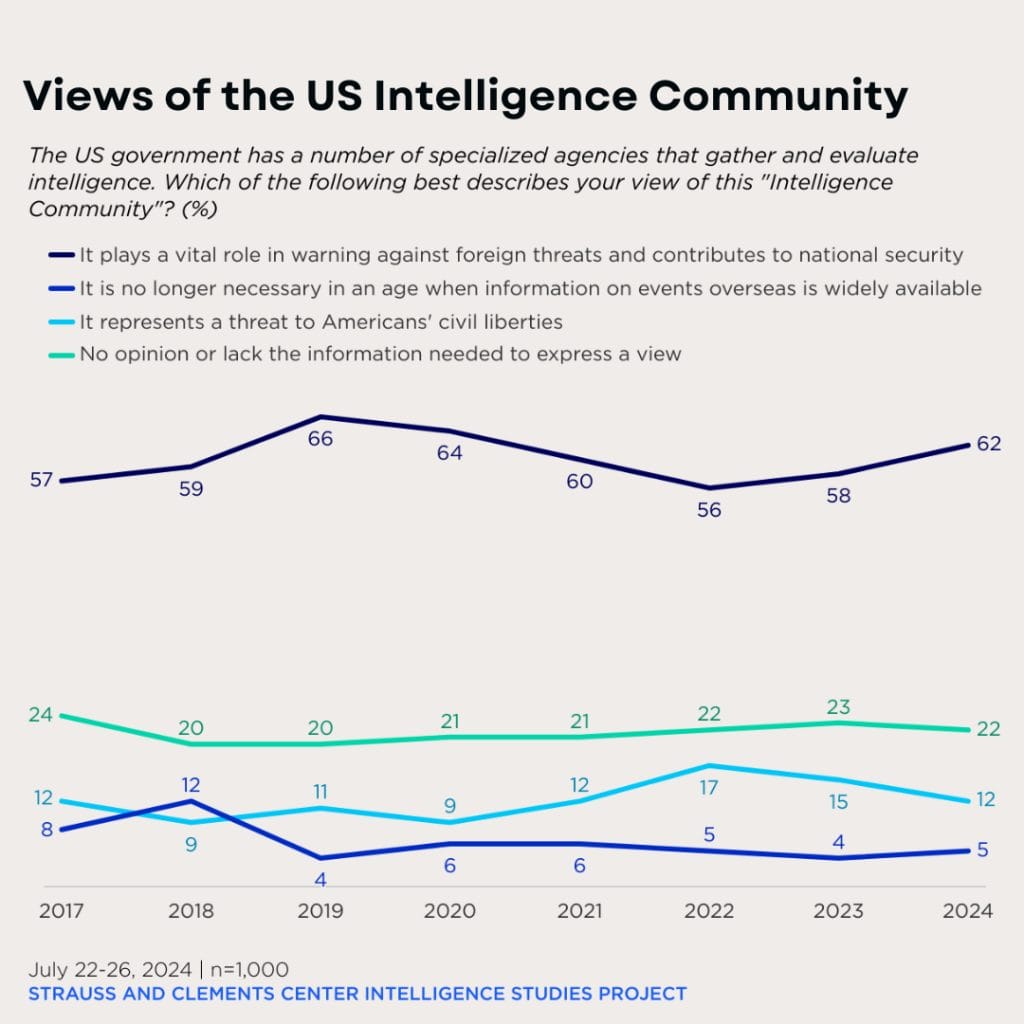
The Chicago Council on Global Affairs published the results of two annual national surveys of public attitudes sponsored by UT-Austin’s Clements-Strauss Intelligence Studies Project. The surveys conducted in 2023 and 2024 confirm that most Americans believe the US intelligence agencies are vital to protecting the nation and effective in carrying out their specialized tasks. These final polls of the Biden presidency also affirm that partisan preference plays a significant role in shaping views on the Intelligence Community’s (IC) performance, respect for civil liberties, and democratic oversight. Over the six-year span of this study, efforts to improve transparency and public understanding of the US IC have not overcome widespread public concern that the country’s security agencies fail to adequately safeguard citizens’ privacy rights and civil liberties. The surveys were designed and analyzed by ISP Director Stephen Slick, ISP’s Program Manager Kim Nguyen, and Strauss Center Distinguished Scholar Joshua Busby. Key takeaways, the conclusion, and two figures depicting views of the IC appear below. The full report with underlying survey data is available HERE.
Key Takeaways
- Most Americans believed that US intelligence agencies are necessary and play a vital role in protecting the nation (62% in 2024).
- Relatively few Americans believed the IC is no longer needed (5% in 2024) but a sizable number (12% in 2024) of Americans expressed concern that the intelligence agencies represented a threat to their civil liberties.
- An overwhelming majority of Americans rated the intelligence agencies as highly effective in accomplishing core missions like preventing terror attacks (83%) and discovering the plans of hostile governments (80%). However, fewer than half of Americans believed the IC was effective in protecting their privacy rights (48%).
- Partisan differences described in previous reports were present in the 2023 and 2024 data and appear more deeply entrenched in public attitudes toward US intelligence. Americans’ views on the effectiveness, respect for privacy rights, and institutional oversight of the intelligence agencies were each notably impacted by partisan affiliation.
- Four in 10 Americans (40%) learned about US intelligence from traditional media sources while one in four (25%) relied on social media. Age plays the most significant role in news sources, with older Americans following traditional print and electronic outlets while younger cohorts cited social media sources. Only 1 percent of Americans said they relied on popular culture portrayals of US intelligence.

Conclusion
With a second Trump administration beginning in 2025, our next survey should provide some visibility on whether the pattern of partisan re-sorting of support for the US IC occurs again. With new leadership atop the IC and other broader changes in budgets and foreign policy priorities, 2025 is likely to be a consequential year for US foreign policy broadly and the IC in particular. Public perceptions of the IC and its contributions to our security will be an important measure of the agencies’ impact and relevance.