

Striking the Ayatollah: War Powers, Political Order and Consequences
March 4, 2026 | 12:15PM - 1:30PM
Bass Lecture Hall - LBJ School of Public Affairs
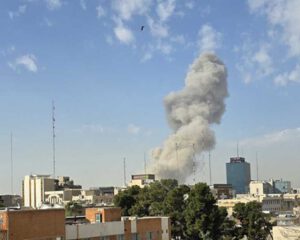
On Wednesday, March 4, 2026, the Intelligence Studies Project, Clements Center for National Security, and the Strauss Center for International Security and Law convened an expert panel for a public event, “Striking the Ayatollah: War Powers, Political Order and Consequences.” See below to view the video.
The expert panel’s participants included General (Ret.) Vince Brooks, U.S. Army, Former Commander, United Nations Command/Combined Forces Command/United States Forces Korea; Distinguished National Security Fellow, Clements Center for National Security and Strauss Center for International Security and Law, Adam Klein, Director of the Strauss Center for International Security and Law, Paul Pope, Senior Fellow at the Intelligence Studies Project, and Steve Slick, Former Director of the Intelligence Studies Project. Alexandra Sukalo, Director of the Intelligence Studies Project, moderated the panel, and Paul Edgar, Deputy Executive Director of the Clements Center for National Security, introduced the panel. For event photographs, click HERE.
PANELIST BIOGRAPHIES
General (Retired) Vincent “Vince” Brooks served in the U.S. Army for over 42 years from his entry into the U.S. Military Academy at West Point until his retirement from active duty in 2019 as a four-star general. Brooks spent his final seventeen years of service in the general officer ranks and in nearly all of those years in command of large, complex military organizations in challenging situations.
His military service includes tours of duty in Europe, the Middle East and Central Asia, the Western Hemisphere, and the Indo-Pacific Region as well as the American Homeland.
In his post-military career, General Brooks is a board director for three public companies (Diamondback Energy, Verisk Analytics, Jacobs) one non-profit organization (Gary Sinise Foundation) and is former board chair and President of the Korea Defense Veterans Association. He is a consultant principal with a prominent national security consulting firm (WestExec Advisors). He is also a member of the Defense Advisory Committee on Diversity and Inclusion and also holds an endowed chair at West Point as the Class of 1951 Chair for the Study of Leadership. General Brooks is a member of the Council on Foreign Relations and is also a Fellow at three prestigious intellectual centers (Belfer Center at Harvard Kennedy School, Clements Center for National Security at University of Texas, and Strauss Center for International Security and Law at University of Texas).
He holds a Bachelor of Science from the U.S. Military Academy at West Point, a Master of Military Art and Science from the U.S. Army School of Advanced Military Studies, an Honorary Doctor of Laws from New England School of Law, and an Honorary Doctor of Humanities from New England Law | Boston.
Adam Klein is Director of the Robert Strauss Center for International Security and Law at the University of Texas at Austin. He also holds a faculty appointment at the University of Texas School of Law, where he teaches courses on counterterrorism, foreign relations, intelligence, government surveillance, and AI, and chairs the university’s Advisory Committee on Classified Research.
Before joining the Strauss Center, Adam served as Chairman of the United States Privacy and Civil Liberties Oversight Board, the independent, bipartisan federal agency responsible for overseeing counterterrorism programs at the NSA, FBI, CIA, Department of Homeland Security, and other federal agencies. As the Board’s Senate-confirmed Chairman, he oversaw its oversight and advice engagements with other federal agencies, while also serving as the Board’s chief executive officer.
Before entering government, Adam was the Robert M. Gates Senior Fellow at the Center for a New American Security, a bipartisan national-security research institution in Washington, DC. There, his research focused on government surveillance, intelligence powers, and national security law.
Previously, Adam practiced law in Washington, DC, and served as a law clerk to Justice Antonin Scalia of the U.S. Supreme Court and Judge Brett Kavanaugh of the U.S. Court of Appeals for the D.C. Circuit. He has also worked on national-security policy at the RAND Corporation, the 9/11 Public Discourse Project (the non-profit successor to the 9/11 Commission), and in the U.S. Congress. He received his BA from Northwestern University and his JD from Columbia Law School.
J. Paul Pope retired from the CIA after multiple foreign tours, service as Chief of Station, and assignments as a Chief, Deputy Chief, and Chief of Ops in the Directorate of Operations’ three largest components. As Chief of Training and Tradecraft Division, he was responsible for DO training, capture of “lessons learned,” and adapting to emerging technical challenges and mission imperatives. He was acting ADNI for Partner Engagement for an extended period and Head of Delegation to NATO’s Civilian Intelligence Committee. Pope was DNI/DCIA Representative to Commander, US Pacific Command and his component commands. Prior to the NCS, he served on the National Intelligence Council for the Near East and South Asia and led an analytic unit in the Directorate of Intelligence. Pope was an Army officer, with service on the Army General Staff after twice commanding at the company level, including command of the only active firebase in the Army on the Korean DMZ. He received his M.A. With Distinction from the Naval Postgraduate School and BS from the United States Military Academy at West Point. He is a Distinguished Graduate of Command and General Staff College and a graduate of the National War College’s CAPSTONE course.
Stephen B. Slick served as the inaugural Director of the Intelligence Studies Project, a joint partnership between the William P. Clements Center for National Security and the Robert S. Strauss Center for International Security and Law. He retired in 2014 after 28 years as a member of CIA’s clandestine service. He retired in 2025.
Between 2005 and 2009, Steve served as a special assistant to the president and the Senior Director for Intelligence Programs and Reform on the staff of the National Security Council. He was previously the Director for Intelligence Programs at the NSC. While serving at the White House, Steve participated in efforts to restructure and reform the intelligence community informed by recommendations of the commissions charged with investigating the 9/11 attacks and the flawed pre-war analysis of Iraq’s unconventional weapons programs. These efforts included a series of executive orders on U.S. intelligence issued in August 2004, key provisions in the Intelligence Reform and Terrorism Prevention Act of 2004, the administration’s responses to recommendations by the “WMD Commission”, as well as significant amendments to Executive Order 12333 that were approved by President George W. Bush in 2008.
Steve completed five overseas tours as a CIA operations officer and manager, including service from 2009 to 2013 as the chief of station and director of national intelligence’s representative in a Middle Eastern capital. His assignments at CIA Headquarters included service as an executive assistant to the deputy director of central intelligence and leading CIA’s operations in the Balkans. Steve received CIA’s Medal of Merit, Commendation Medal and other awards.
Prior to joining CIA, Steve was a litigation associate at the law firm of Rawle and Henderson in Philadelphia. Steve received a B.A. from the Pennsylvania State University, J.D. from the UCLA School of Law, and Master in Public Policy from Princeton University’s Woodrow Wilson School of Public and International Affairs.
Alexandra Sukalo is the Director of the Clements-Strauss Intelligence Studies Project and an Assistant Professor of National Security Affairs at the LBJ School of Public Affairs. She is a historian of Russia and Eastern Europe. Her research and teaching focus on Russian and Soviet intelligence and security services, the Russian and Soviet military-industrial complex, as well as the Russian and Soviet nuclear and ballistic missile programs.
Sukalo is completing a book manuscript on the Soviet Union’s domestic intelligence and security services under Stalin. Her dissertation, upon which her book is based, won the University of Texas at Austin’s Bobby R. Inman Award for excellence in student scholarship on intelligence. Her second book project, entitled The Soviet Nuclear Empire, examines the development and workings of the Soviet nuclear industry. Her work has been featured in the Washington Post, War on the Rocks, and the journal of Intelligence and National Security.
Prior to joining the LBJ School of Public Affairs, Sukalo was an Assistant Professor of Modern Russian History and Security Policy at the Naval Postgraduate School in Monterey, California. She earned her PhD and MA in history from Stanford University. She also received an MA in European and Russian Studies from Yale University, and she holds a BA in political science from Barnard College. She completed a Postdoctoral Fellowship at the Clements Center for National Security at the University of Texas at Austin.
Prior to her academic appointments, Sukalo also worked as a Eurasian analyst for the National Geospatial-Intelligence Agency and the Central Intelligence Agency.
Paul Edgar is the Deputy Executive Director of the William P. Clements, Jr. Center for National Security at the University of Texas-Austin. He holds a PhD in Middle Eastern Languages and Cultures from the University of Texas and studies the historical origins of diplomacy, war, and strategy in pre-classical antiquity. He is also a philologist of several ancient languages. As a graduate student, he was a fellow in the Andrew W. Mellon Foundation’s Engaged Scholar Program and also with the Clements Center. Prior to beginning work on his PhD, Paul had been an Olmsted Foundation Scholar at Tel Aviv University where he studied for his master’s degree, focusing on early Israelite and Jewish literature from the Iron Age through the Crusades. Previously, Paul earned his Bachelor of Science degree in chemistry from Saint Mary’s University. His public writing has appeared in Foreign Policy, Task & Purpose, and Capital Commentary. He is currently writing an international diplomatic history of the Late Bronze Age.
Before entering academia, Paul served more than 22 years as an infantry officer in the U.S. Army, mostly in conventional airborne and special operations assignments.