

HOT SPOT BRIEFING – The Cuba Conundrum: Continuity, Cautious Cooperation, or Chaos?
October 28, 2026 | 12:15PM - 1:45PM
Bass Lecture Hall - LBJ School of Public Affairs
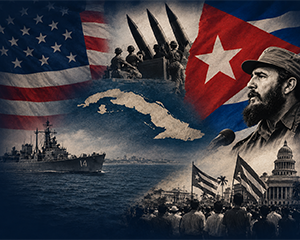
The United States and Cuba have had a complex relationship since 1898 when future President Teddy Roosevelt charged up San Juan Hill in the definitive battle in Cuba during the Spanish-American War. The relationship worsened when Fidel Castro led the Cuban Revolution in 1959, and after decades of conflict, including being on the precipice of nuclear war, the relationship is now on the brink of dramatic change.
On Wednesday, October 28, the Clements-Strauss Intelligence Studies Project (ISP) will host a public event, “The Cuba Conundrum: Continuity, Cautious Cooperation, or Chaos,” with Timothy Langford, former National Intelligence Officer for the Western Hemisphere and the Director of National Intelligence’s Cuba Mission Manager between 2007-2009. This Hot Spot Briefing will explore the history of US-Cuban relations and identify alternative futures as we enter uncharted waters. Special attention will be given to the outsized roles US and Cuban intelligence services have played in this drama on the world stage.
Join ISP for our Hot Spot Briefing series where attendees receive a deep dive into a region or country’s history and security-related environment. The event marks the second Hot Spot Briefing of the fall semester and is free and open to the public.
- Registration is required.
- Garage parking is available for a fee at the Manor Garage and the San Jacinto Garage. Parking will not be validated.
Biography: Mr. Timothy Langford served over 30 years in a variety of senior positions in the U.S. intelligence and policy communities before retiring from federal service in 2020. His final position was in the Office of the Director of National Intelligence as the National Intelligence Officer for the Western Hemisphere. In that post, he served as the U.S. Intelligence Community’s senior analyst responsible for leading strategic analysis in Latin America, the Caribbean, and Canada. Since his retirement, he has served as a consultant to a variety of U.S. Government (USG) and private sector organizations.
During his government service, Langford served in Washington D.C. and 15 years at U.S. embassies in Latin America and Europe. He is a widely recognized expert on Latin America and military and security issues, particularly Mexican politics, organized crime, narcotics trafficking, and terrorism. He has extensive experience writing for, briefing, and interacting with top-level USG executive and legislative branch officials, as well as senior foreign government officials, including heads of state.
During his career, Langford gained extensive experience in intelligence fusion and collaboration. In the early 2000s, he established and led an innovative multi-U.S. agency fusion center to assist the Colombian Government defeat insurgent groups and combat narcotics traffickers. He subsequently established and led similar units in other Latin American countries.
Langford also has extensive experience working with the U.S. military, serving as the U.S. Intelligence Community’s senior representative to U.S. Southern Command in Miami, Florida from 1998 to 2002 and Special Operations Command in Tampa, Florida from 2014 to 2016.
Langford graduated from The University of Texas at Austin in 1984 with a Master of Arts in Latin American Studies. He holds an undergraduate degree with majors in anthropology, Spanish, sociology, and Ibero-American Studies from Eastern Kentucky University. He speaks Spanish in addition to his native English.